Singapore's AI Strategy and Status
Strategic Imperative: Singapore's Artificial Intelligence Ecosystem and Adoption Trajectory in 2026
In an era defined by rapid fragmentation of global supply chains, intensifying geopolitical competition over advanced technologies, and the urgent need for sovereign digital resilience, Singapore has positioned artificial intelligence at the center of its national economic and strategic agenda. The passage of the historic S$154.7 billion Budget 2026 marks a decisive inflection point, establishing a new National AI Council chaired directly by the Prime Minister and centralizing the strategic direction of the nation's AI ecosystem.
1. Executive Synthesis and Macroeconomic Context
Singapore's AI strategy is driven by the imperative to maintain competitiveness amid global technological shifts. Budget 2026 allocates substantial resources to compute infrastructure, talent development, and industry adoption. The formation of the National AI Council signals a whole-of-government approach, integrating economic policy, digital development, healthcare, workforce transformation, and financial sector oversight under a unified AI mandate.
2. The Foundational Policy Architecture: NAIS 2.0 and Smart Nation 2.0
The original National AI Strategy (NAIS 1.0), launched in 2019, focused on discrete projects and rudimentary capability building. NAIS 2.0, introduced in late 2023, represents a structural evolution—abandoning the project-by-project approach in favor of five strategic pillars: Talent & Ecosystem, Data & Infrastructure, Governance & Trust, Industry Adoption, and International Collaboration.
This AI-specific strategy is inextricably linked to the broader Smart Nation 2.0 blueprint, unveiled by Prime Minister Lawrence Wong. The integration recognizes that ubiquitous AI deployment introduces profound societal, ethical, and infrastructural considerations that extend beyond narrow technical domains.
3. Institutional Restructuring and Budget 2026 Deployments
The February 2026 Budget and subsequent Committee of Supply (COS) debates detailed significant institutional and financial commitments. Key developments include the National AI Council, the National AI Impact Programme (NAIIP), and expanded Enterprise Innovation schemes designed to overcome institutional inertia and stimulate executive behavior.
3.1 Centralization of Authority: The National AI Council
The most significant structural development is the formation of the National AI Council. The Council comprises senior ministers covering Prime Minister & Finance (strategic direction, budgetary allocation), Trade & Industry (economic integration, enterprise adoption), Digital Development (infrastructure, agentic AI safety, cybersecurity), Health (healthcare AI, super-aged demographic), Manpower (workforce transformation, talent attraction), National Development & MAS (financial sector AI, systemic risk), and Transport (logistics, seaport/airport optimization).
This inter-ministerial composition ensures that AI policy is coordinated across economic, social, and technological dimensions rather than siloed within a single agency.
3.2 The National AI Impact Programme (NAIIP)
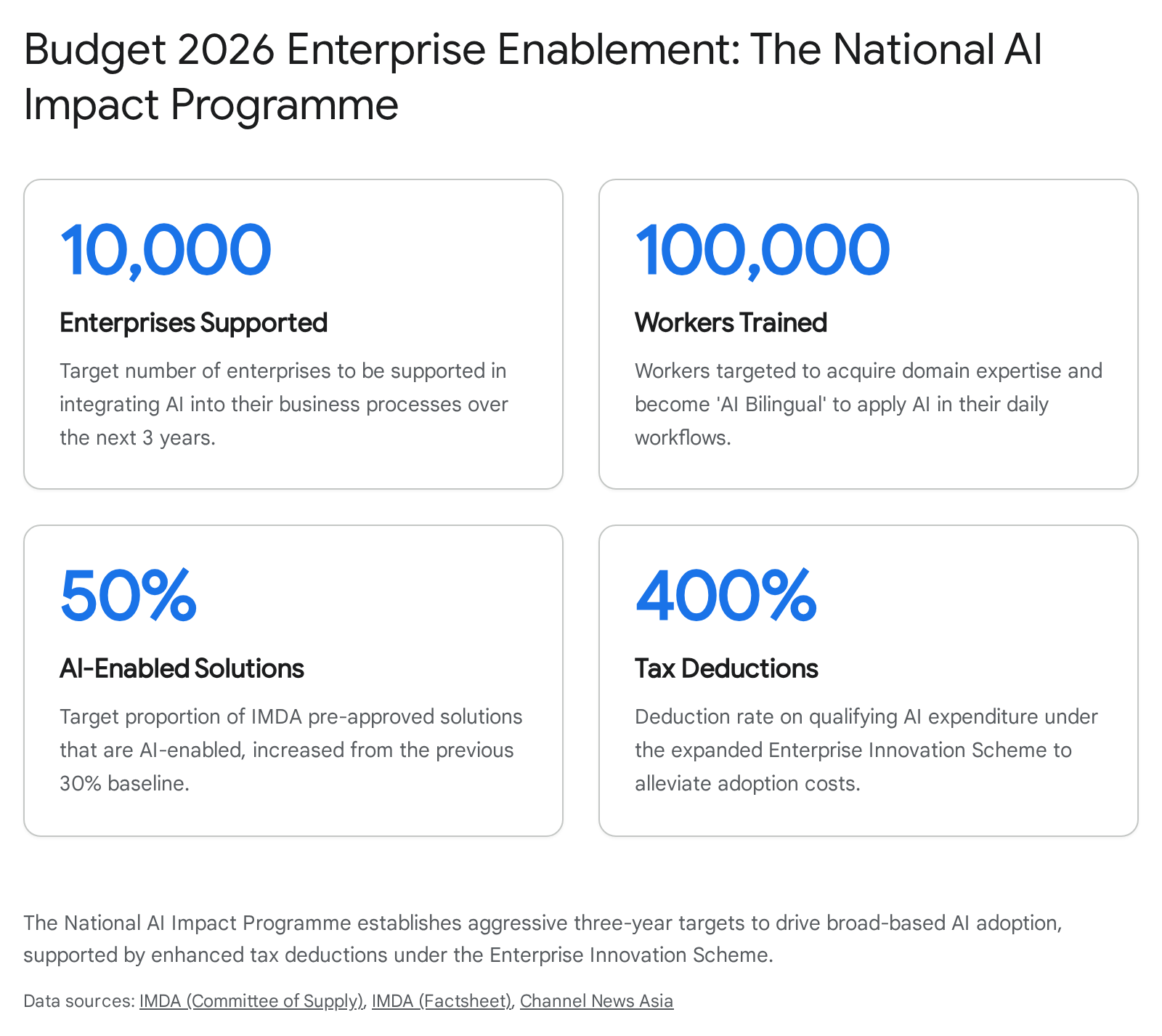
Recognizing that macroeconomic success depends on broad-based enterprise adoption rather than localized excellence among a few firms, NAIIP establishes aggressive targets to force market adaptation. The programme targets tripling the local AI practitioner workforce to 15,000 within 3–5 years, with S$1B+ allocated for compute, talent, and industry development. Estimated economic uplift from AI could reach US$198B in gross value added by 2030.
To stimulate adoption, the government radically expanded the Enterprise Innovation schemes, providing grants and support for SMEs to integrate AI into their operations.
4. The Sectoral Paradigm: Orchestrating the National AI Missions
While NAIIP focuses on broad-based SME support, the National AI Council has mandated highly targeted National AI Missions for industries representing the core of Singapore's economy. These sectoral missions—spanning finance, healthcare, logistics, manufacturing, and government services—combine public-sector coordination with private-sector execution to accelerate adoption in high-impact domains.
The rationale for selecting these industries is calculated: they represent sectors where AI can deliver measurable productivity gains, regulatory alignment is feasible, and Singapore has existing comparative advantages to build upon.
5. Strategic Conclusions
Singapore's 2026 AI strategy reflects a deliberate, top-down approach to technological adoption. By centralizing authority in the National AI Council, allocating substantial budgetary resources, and structuring both broad-based (NAIIP) and sector-specific (National AI Missions) interventions, the government has created a comprehensive framework for AI-driven economic transformation.
For enterprises operating in or engaging with Singapore, the implications are clear: AI adoption is no longer optional but a strategic imperative aligned with national policy. Organizations that align their AI roadmaps with NAIS 2.0 priorities—particularly in talent development, data governance, and sectoral applications—will be well-positioned to benefit from government support and market opportunities.